TRAINING

Aptitude & Skills

Excellent customer service is the most important skill you can bring to any role in aviation.

APTITUDES SKILLS

Customer services

You must feel comfortable interacting with others and being near them. The most important skill you can contribute to any role in aviation is excellent customer service. Customer service representatives who answer your inquiries and check-ins, and flight attendants who interact with passengers over extended periods of time, are just a few of the positions available. Industry recruiters favour candidates who can demonstrate patience, listening skills, problem-solving abilities and the capacity to work together in a team.

Employers need people with the capacity to adjust to changes in the daily routine due to the constantly changing nature of a day in the aviation business. This ability is preferred to help you handle difficult situations that can emerge throughout the day, during a flight, or those that call for last-minute judgements. You have a better chance of getting a job in aviation if you have the capacity to address difficulties quickly and calmly.

Agent returning a lost phone to a traveller
PLEASE NOTE
NIA never charges any amount through agents.
PwD candidates are not eligible for this recruitment.
Invalid or incomplete applications will be rejected.
ROLE YOU HAVE TO PLAY

Role you have to play

There are different kinds of duties you have to follow and must have knowledge about:

Interaction

Clear communication can mean the difference between life and death in numerous aviation positions, including flight crew, cabin crew and air traffic control. The person is responsible for making sure that instructions are comprehended. There are particular words and lingo to master, and face-to-face and distant communication are both required. Communication is also essential in and around airports to maintain the functionality of these busy hubs. To keep up with their rigorous workloads and interact with internal and external clients from all walks of life, ramp and luggage crews, security officers and terminal staff all need to communicate effectively.
Agent crouching to hand a lanyard pouch to a child travelling alone

Analysis of data

Analytical thinking is necessary for aviation occupations involving the organisation and movement of people and aeroplanes. Pilots and air traffic controllers both require great analytical thinking and spatial awareness to coordinate aircraft in the air and reduce delays on the ground.To maximise profitability, airline booking agents must also organise and analyse passenger loads and seating. Law enforcement personnel, such as airport police, customs agents and security personnel, must all assess risk and respond effectively in a variety of circumstances.
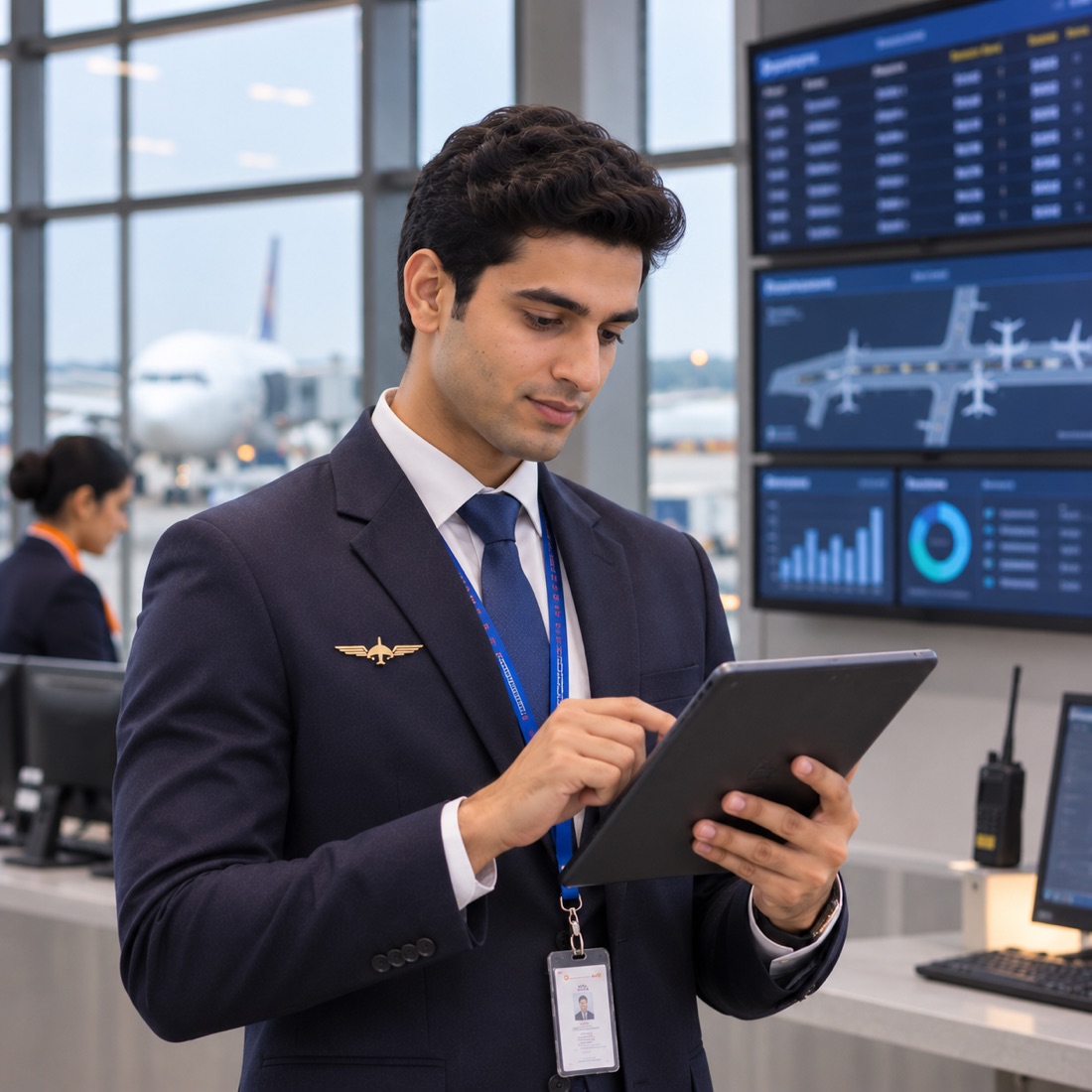
Duty manager reviewing data on a tablet

Interpersonal

The aviation sector is largely one of services, and many positions demand great interpersonal skills. All passengers must receive excellent service from flight attendants, who must also be able to deal with potentially impolite passengers and influence them when necessary. Customers and passengers must be taken care of, frequently to five-star standards, by employees in airport lounges, stores and restaurants. Also, customs and security personnel employ their interpersonal abilities to defuse tense situations.
Supervisor and young agent sharing a laugh over chai

Teamwork

The aviation industry has many uses for teamwork, particularly in the complex organisational structures of airports or among the cabin crew, where successful coordination of big teams of people is essential. Things may go wrong very rapidly in the aviation sector if workers don’t work together as a team. Aviation mechanics and engineers place a high importance on teamwork because it takes a variety of technical skill sets to maintain complex systems and machinery.
Four ramp staff lifting a cargo box together

Adaptability

In a lot of cases, shift-based rotas are used in the aviation business. Workers at airports, including those in retail, luggage or hospitality, must adapt to shifting workloads and hurried demands. Employees in flight operations, like pilots or air traffic controllers, must be ready to adapt to last-minute changes and make judgements quickly.
Agents reassuring waiting passengers during a delay and handing out snack boxes

Time management

The Federal Aviation Administration in the United States estimates that aircraft delays cost $22 billion yearly. Time is actual currency. Due to the potential effects on airports and airspace, if an aircraft is even a few minutes late arriving or departing, it is subject to a fee per passenger. Thus, time management skills must be extraordinary for anyone working in commercial aviation.Many pilots are “on call” at home, ready to be called in at a moment’s notice, and more must arrive at the airport well in advance of their trip. Ground crews must complete their responsibilities more quickly to reduce delays, and airport staff members must be ready to move quickly to handle passengers.
Agent checking his watch as he walks through the terminal

Problem solving

In order to move and position aircraft in accordance with shifting priorities, air traffic controllers must have excellent problem-solving abilities. During a flight, pilots may encounter small issues as well, and they must be able to quickly refer to their training and aircraft manuals for solutions. In each of these situations, the issues are not just about safety but also about operating efficiency, which has significant financial repercussions in the aviation industry.

Leadership

Leadership is an essential talent because many airline management professions work in high-risk or high-pressure situations. Senior pilots, including captains, must be able to command the cabin and flight crew in all ordinary and urgent situations. Team leaders for air traffic control must make sure that every minute of the shift is spent operating at peak efficiency. Airport managers, including store managers, top security officials and baggage handler leaders, must also inspire and motivate their staff to produce exceptional results in chaotic settings.
Put your skills to work at the airport
Apply online on the official NIA portal — it takes about 10 minutes.
SUBMIT YOUR QUERY

How may I help you?